3D Scan to 3D CAD Services in Australia
3D Scan to 3D CAD Services in Australia
What Is 3D Scan to CAD?
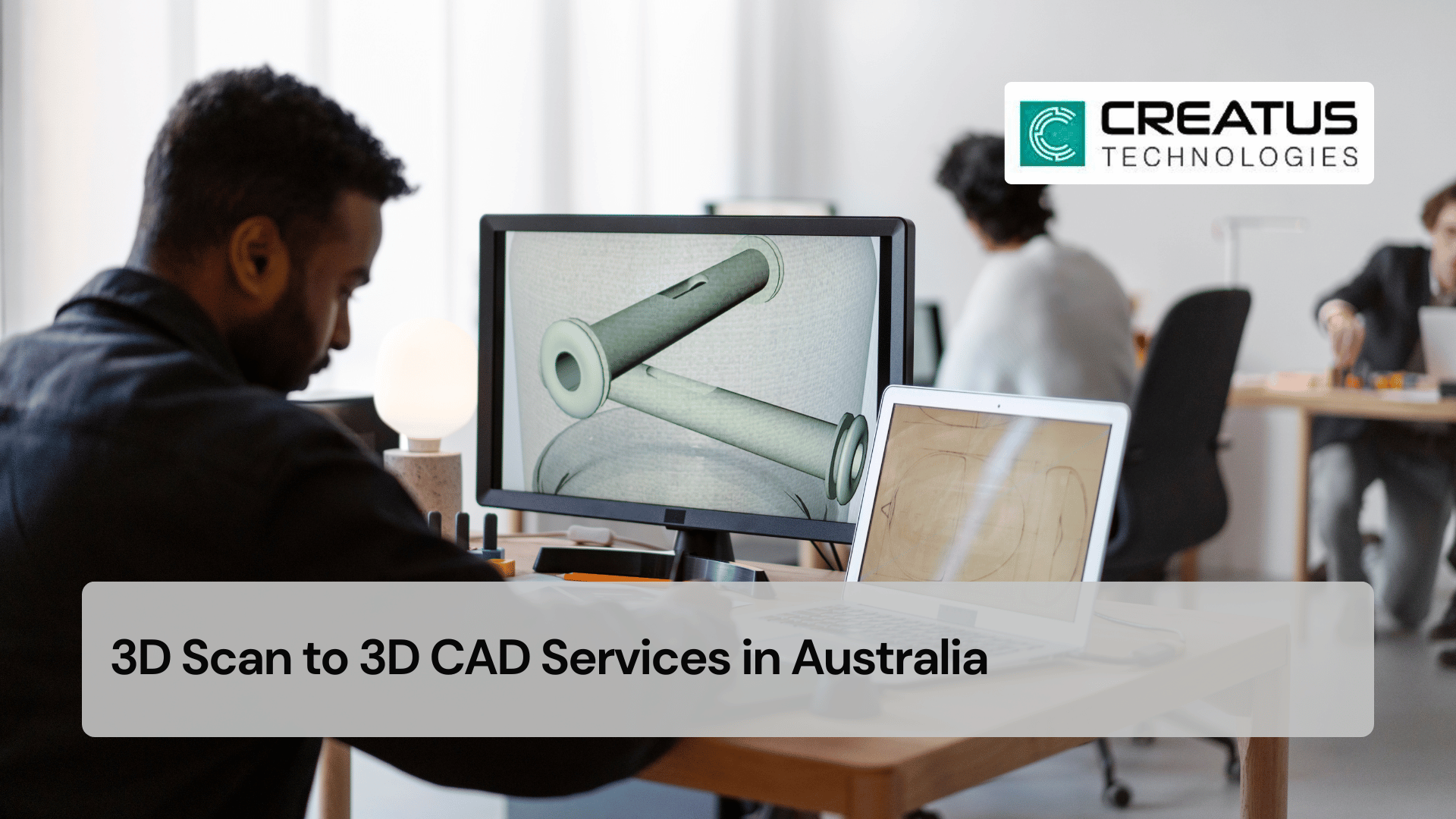
3D scan to CAD is a reverse engineering process that converts a physical object into an editable digital 3D CAD model.
The workflow begins with 3D scanning, which captures millions of spatial data points describing the surface geometry of a part. This data forms a point cloud or polygon mesh.
Specialised software is then used to reconstruct this scan data into a usable CAD model, either:
- Parametric (feature-based) — suitable for manufacturing and design updates
- Non-parametric (surface-based) — suitable for complex or freeform geometry
The final output is a CAD file ready for drafting, analysis, prototyping, or manufacturing workflows.
Why 3D Scan to CAD Is Important in Engineering
3D scan to CAD supports:
- Replacement of legacy or undocumented components
- Redesign or performance improvements
- Manufacturing process validation
- Digital archiving of physical assets
- Inspection comparison against nominal CAD models
It is particularly valuable when:
- Original drawings are unavailable
- Parts are worn or modified
- Geometry is too complex for manual measurement
- Downtime needs to be reduced
The 3D Scan to CAD Process
1. Scanning
Industrial-grade 3D scanners capture the physical geometry of the component.
Output:
- High-density point cloud
- Mesh representation of the surface
Scanning method selection depends on material, size, surface condition, and required resolution.
2. Data Processing
Scan data is:
- Cleaned to remove noise
- Aligned if multiple scans are taken
- Merged into a unified dataset
This ensures the dataset accurately reflects the measurable geometry of the part.
3. CAD Reconstruction
Reverse engineering software converts the mesh or point cloud into structured CAD geometry.
This may include:
- Feature recognition
- Surface modelling
- Parametric solid modelling
- Dimensional constraints
The modelling approach depends on the intended use — manufacturing, redesign, or inspection.
4. Model Refinement
Engineers refine the geometry to:
- Define critical features
- Add fillets, holes, and threads
- Establish datums and references
- Ensure manufacturable geometry
5. Verification & Inspection Comparison
Where required, the reconstructed CAD model is compared back to scan data.
Outputs may include:
- Deviation colour maps
- Dimensional reports
- Tabulated measurement data
This process supports quality evaluation but does not replace certified inspection or compliance approval.
6. Final Delivery
Deliverables may include:
- STEP (.stp)
- IGES (.igs)
- Native CAD formats
- 2D technical drawings (if required)
Common Challenges in 3D Scan to CAD
Data Quality Variability
Surface reflectivity, damage, or occlusion can affect capture quality.
Large File Management
High-resolution scans generate significant data volumes requiring structured processing.
Complex Geometry Reconstruction
Freeform surfaces and organic shapes require advanced surfacing expertise.
File Compatibility
Ensuring interoperability across CAD platforms is essential.
Professional workflows reduce these risks through structured scanning strategy and engineering oversight.
Industry Applications in Australia
Mining & Heavy Equipment
- Reconstructing worn components
- Capturing legacy parts without drawings
- Supporting maintenance and shutdown planning
Manufacturing
- First article comparison
- Tooling validation
- Process variation tracking
Farming & Agriculture
- Custom machinery modification
- Spare part replication for imported equipment
Automotive
- Aftermarket component redesign
- Classic vehicle part reproduction
Food Processing
- Replacement parts for legacy machinery
- Cleanable geometry optimisation
Frequently Asked Questions
What is 3D scan to CAD used for in manufacturing?
It is used to convert physical parts into editable CAD models for redesign, replacement manufacturing, inspection comparison, or digital archiving.
How does reverse engineering with 3D scanning work?
A 3D scanner captures surface geometry as a point cloud or mesh. Engineers then reconstruct this data into a structured CAD model suitable for drafting, analysis, or production.
When should you use 3D scan to CAD instead of manual measurement?
It is suitable when parts are complex, freeform, worn, large-scale, or when no technical drawings exist.
Can 3D scan to CAD models be used for production?
Yes, once properly reconstructed and reviewed, CAD models can support manufacturing workflows. Final production approval remains subject to engineering validation.
What industries use 3D scan to CAD services in Australia?
Mining, manufacturing, agriculture, automotive, and industrial processing sectors frequently use scan-to-CAD for maintenance, redesign, and quality control.