7 Top CAD Skills Every Mechanical Engineer Must Master in 2026
7 Top CAD Skills Every Mechanical Engineer Must Master in 2026
Creatus Technologies is revolutionising the manufacturing industry in Australia with cutting-edge mechanical design solutions. If you want to stay ahead in 2026, understanding the most in-demand CAD skills is essential. Companies are no longer just hiring degree holders—they want industry-ready engineers who can design, analyze, and collaborate digitally across sectors like automotive, aerospace, and industrial manufacturing.
Whether you are a mechanical engineering student or a working professional in Australia, mastering these skills can unlock high-paying jobs, global opportunities, and growth in fields like Plastic, BIW, Casting, Forging, and Sheet Metal.
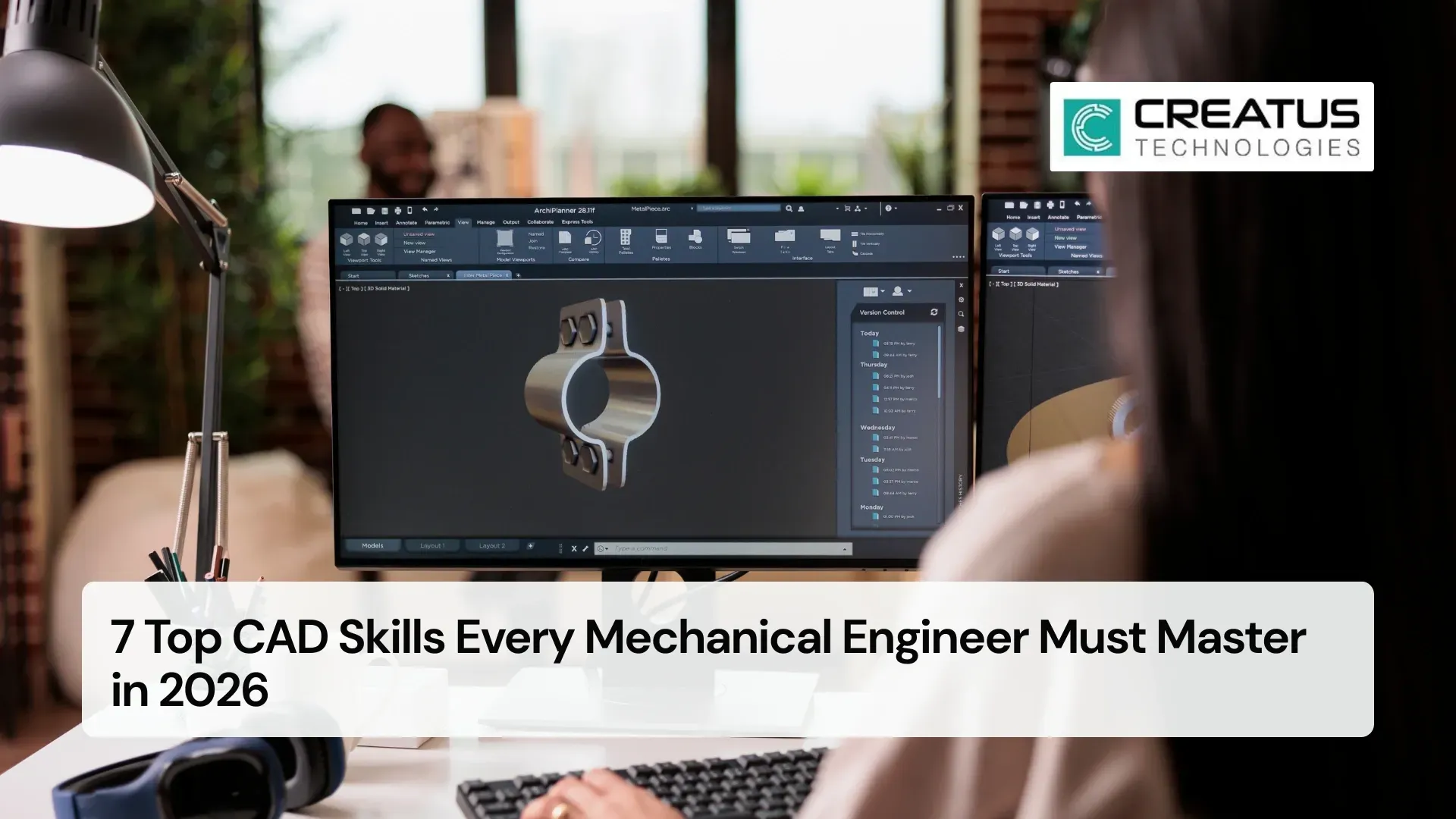
1. Advanced 3D Modeling Skills
Basic 3D modeling is no longer enough. In 2026, employers expect engineers to handle complex assemblies, surface modeling, and design optimization.
Skills to master:
- Parametric and feature-based modeling
- Surface modeling for automotive and plastic components
- Assembly design with large datasets
- Design intent management
Software to focus on:
- CATIA V5 & 3DEXPERIENCE
- SolidWorks
- CREO & Siemens NX
These tools are standard in Australian and global automotive, aerospace, and manufacturing industries.
2. Mastering GD&T and Manufacturing Drawings
Strong knowledge of Geometric Dimensioning & Tolerancing (GD&T) sets top engineers apart.
What to learn:
- ASME & ISO standards
- Tolerance stack-ups and datum systems
- Functional dimensioning
- Production-ready drawing creation and interpretation
Engineers who communicate clearly with manufacturing teams are highly valued in Melbourne, Sydney, and Brisbane manufacturing hubs.
3. Sheet Metal Design Expertise
Sheet metal design remains a top hiring area for mechanical engineers.
Key skills include:
- Flat pattern development
- Bending allowances & K-factor calculations
- Manufacturing feasibility & tooling considerations
Sheet metal expertise is highly sought after in automotive, HVAC, and industrial equipment sectors across Australia.
4. Plastic Product Design Skills
With demand for lightweight and cost-effective products, plastic design knowledge is crucial.
Skills to focus on:
- Injection molding fundamentals
- Draft, ribs, bosses, and snaps
- Core-cavity and parting line concepts
- Wall thickness optimization & sink mark prevention
Combining plastic design expertise with CATIA or NX CAD opens doors to top OEMs and suppliers in Australia.
5. BIW & Automotive Design Knowledge
For those aiming at the automotive industry, Body-in-White (BIW) design is a must.
Skills to master:
- Spot and seam weld design
- Structural reinforcements
- Automotive standards compliance
- Assembly sequencing
BIW designers with strong CAD skills are among the highest-paid mechanical engineers in Australia.
6. Simulation & Design Validation Basics
Even if you’re not a full-time analyst, basic simulation skills are highly valued.
Learn:
- Part-level stress & strength analysis
- Material behaviour & design validation
- Optimization for performance and efficiency
Engineers who design with performance in mind are in demand across Australia’s manufacturing industry.
7. AI Awareness in Mechanical Design
AI is becoming a tool—not a replacement. Engineers who leverage AI in design will outperform those who don’t.
Focus on:
- AI-assisted CAD workflows
- Generative design concepts
- Optimization through AI
- Understanding AI limitations
Human judgment combined with AI expertise ensures you stay relevant in Australia’s rapidly evolving mechanical engineering sector.
Contact Creatus Technologies Today
Experience confidence and reliability with a leading team of engineering solution experts in Australia.
📞 02 4030 2314 | 0423 393 627
✉️
info@creatustech.com.au